Talk Show Set Design: What a Modern Talk Show Stage Includes

Search for talk show set design and most of what comes back is fan photography. Tours of famous studios, before-and-after renovations. Useful for inspiration, useless for a spec. If you’re the producer or the designer who actually has to put a talk show on its feet, what you need is the parts list: what every talk show set includes, what each piece is doing for the show, and where the money goes. That’s this guide, the anatomy of a modern talk show stage, and then how a virtual stage changes the math on every element. We’ve been taping talk shows on ours since 2007, so the second half is first-hand.
The talk show desk: home base
Every talk show has a home base, and the desk is the classic version. It does three jobs at once. It gives the show geography. The audience always knows where the host lives in the frame, and the American convention seats the host on one side with guests brought to the other, so the coverage never has to reinvent itself. It gives the host authority and a place to put the rundown, notes and props. And its front face is a branding surface: the desk panel is often the most-seen graphic on the show.
Speccing a talk show desk is mostly ergonomics. Host and guest eyelines should land close to level, mismatched chair heights read instantly on a two-shot. The desktop needs cable routing for concealed monitors and cue lights. And the desk must sit high enough to matter but low enough that a seated host’s face isn’t buried in the frame on the wide.
The desk isn’t the only home base. Morning shows run a couch-and-armchair arrangement; daytime panel shows seat everyone at one long desk; sports formats use a raised panel desk built for four; interview-forward shows drop the desk entirely for two chairs and a side table. The format decides. But every version is solving the same problem: a fixed, repeatable anchor the whole show returns to.
One design note that matters more than it seems: the desk should be real even when the set isn’t. On our stages the environments are virtual, but the desk, chairs and foreground props are physical. They blend seamlessly into the virtual set, and the host has something solid to sit behind.
The backdrop: where the show’s identity lives
The talk show background behind the desk is the single biggest design decision on the set, because it’s on screen in nearly every shot. The established looks are established for a reason:
- The city window. The late night talk show set standard, the desk in front of a window wall with a glittering night skyline behind it. It says this show broadcasts from the center of the city, whichever city that needs to be.
- The skyline mural or scenic backing. The same statement without the window frame. Common on daytime and syndicated shows.
- Brick and neon. The comedy-club look: exposed brick, warm practicals, neon signage. It signals stand-up roots and a looser register.
- Morning-show daylight. Bright windows onto a street or plaza, warm wood, a couch. The design language of energy and earliness.
- The upscale interior. Bookshelves, a fireplace, a lounge, the intimate look interview-led shows use to feel like a conversation rather than a broadcast.
Whatever the look, the property that separates broadcast from webcast is depth. A flat printed backdrop reads as flat immediately; a backdrop with layers, window frame in front of buildings in front of sky, holds up on camera moves and long lenses. And it has to be consistent: episode 40 must match episode 1, which is why physical backdrops mean maintenance, touch-up paint and careful storage between seasons.
Lighting: keyed to the seats, repeatable across episodes
Talk show lighting is portrait lighting multiplied by every seat on the set. Each position, host, guest one, guest two, gets its own key and fill, with backlight to lift talent off the backdrop. The backdrop is lit separately from the talent so the two can be balanced against each other, and if there’s an audience, it gets its own soft wash at a lower level so reaction shots cut in without a jarring exposure shift.
The discipline that makes a talk show sustainable is the documented lighting plot. The show tapes daily or weekly for years; the lighting must be identical every time, or episodes stop cutting together. Color temperature is part of the identity too, late-night looks run cooler and moodier, morning shows bright and warm, and once chosen, it’s locked.
Stage layout: cameras, audience, and the second performance area
A talk show stage setup is built backward from the coverage. The standard is three cameras, a wide master, a single on the host, a single on the guest, with bigger shows adding a fourth or a jib for the sweeping shots that open the show and button the act breaks. The home base is placed against the strongest backdrop, and the camera positions are set so all three angles are clean at once; everything else on the floor is arranged to stay out of those lanes.
Then the layout adds, in order of ambition:
- A second performance area. A stand-up mark, a music position, or a demo area, so the show can leave the desk without a reset.
- A band riser. Traditionally stage-left or stage-right of home base, angled so the band leader and host can play off each other on camera.
- Audience seating. Raked or tiered, so every row sees the desk over the camera line. Sightlines are the whole game. Our Burbank studio keeps tiered audience seating for multi-camera tapings.
- Monitor and prompter positions, placed where talent can see them and cameras can’t.
On our stages the coverage infrastructure is standing equipment: a three-camera configuration, with a jib in Burbank and a telescoping crane in Albuquerque available for the moves.
The teleprompter
Every scripted moment on a talk show, the monologue, the intros, the sponsor reads, runs through a teleprompter mounted on the host camera, so the host reads while looking dead down the lens. The prompter workflow is tied to the rundown: an operator scrolls with the host’s natural pace, holds during ad-libs, and jumps when segments get cut on the fly.
On our stages the teleprompter system, the hardware, is included with the stage; a prompter operator is available as part of the optional crew package. If you’re comparing facilities, ask that question precisely: “teleprompter included” can mean the glass or the person, and they’re different line items.
How a virtual stage changes every element
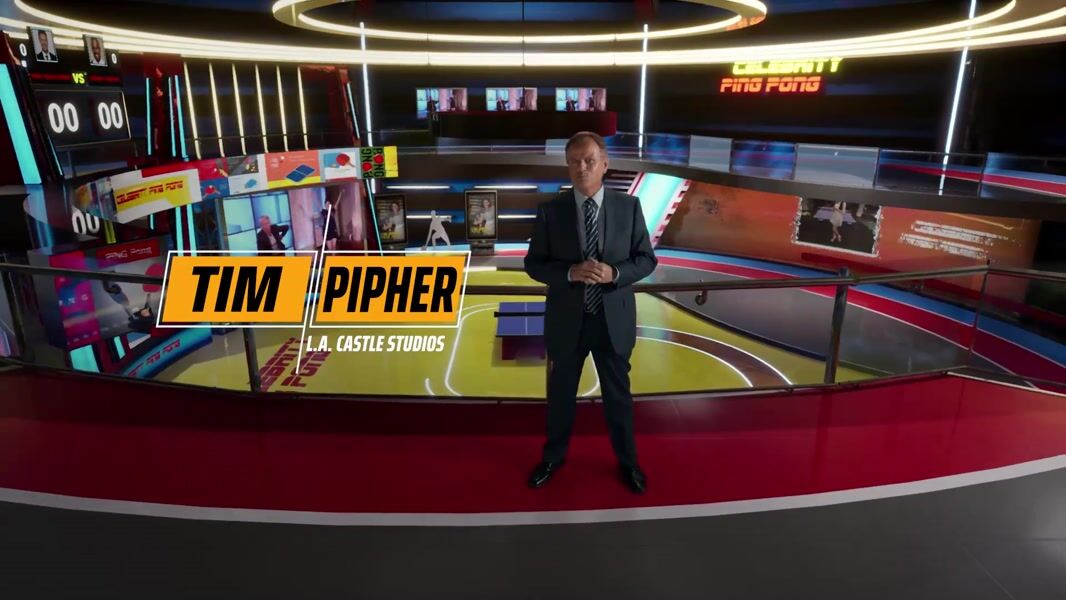
Everything above describes what the set must do. The traditional way to get it is construction. The other way is a virtual talk show set: the environment exists as a photoreal 3D world, and the cameras composite it live, green screen, Unreal Engine, Ultimatte, so the finished look is in camera on the day, not added in post. This is virtual production beyond LED walls: no wall at all, just the final image in the viewfinder. We pioneered real-time virtual production in 2007, now patented, and it changes each element of the anatomy:
- The desk stays real. Foreground furniture and props are physical and blend into the environment. The host’s home base is exactly as solid as on a built set.
- The backdrop becomes a decision, not a construction project. The city window, the brick wall, the morning loft and the upscale interior are all loadable looks. Swap between them in minutes, not build weeks. The skyline outside the window can change between segments; it can be night in the window at two in the afternoon. Start from the library: the upscale news & talk show sets, the morning show set, the sports talk set.
- Depth is native. The virtual environment is a true 3D world, so the backdrop has real parallax on camera moves, the thing scenic backdrops imitate, virtual sets simply have.
- Consistency is automatic. The environment is a file. Episode 40 matches episode 1 without touch-up paint, and the look survives hiatuses, season breaks and revivals at zero storage cost.
- The layout serves more shows. Because the world swaps, the same stage is a late-night talk show set on Monday and a morning show on Tuesday, with lighting keyed to a repeatable plot.
- The crew model is explicit. The virtual system operator, the person driving the environments in real time, is always included in the rate; camera operators and a teleprompter operator are available as an optional crew package.
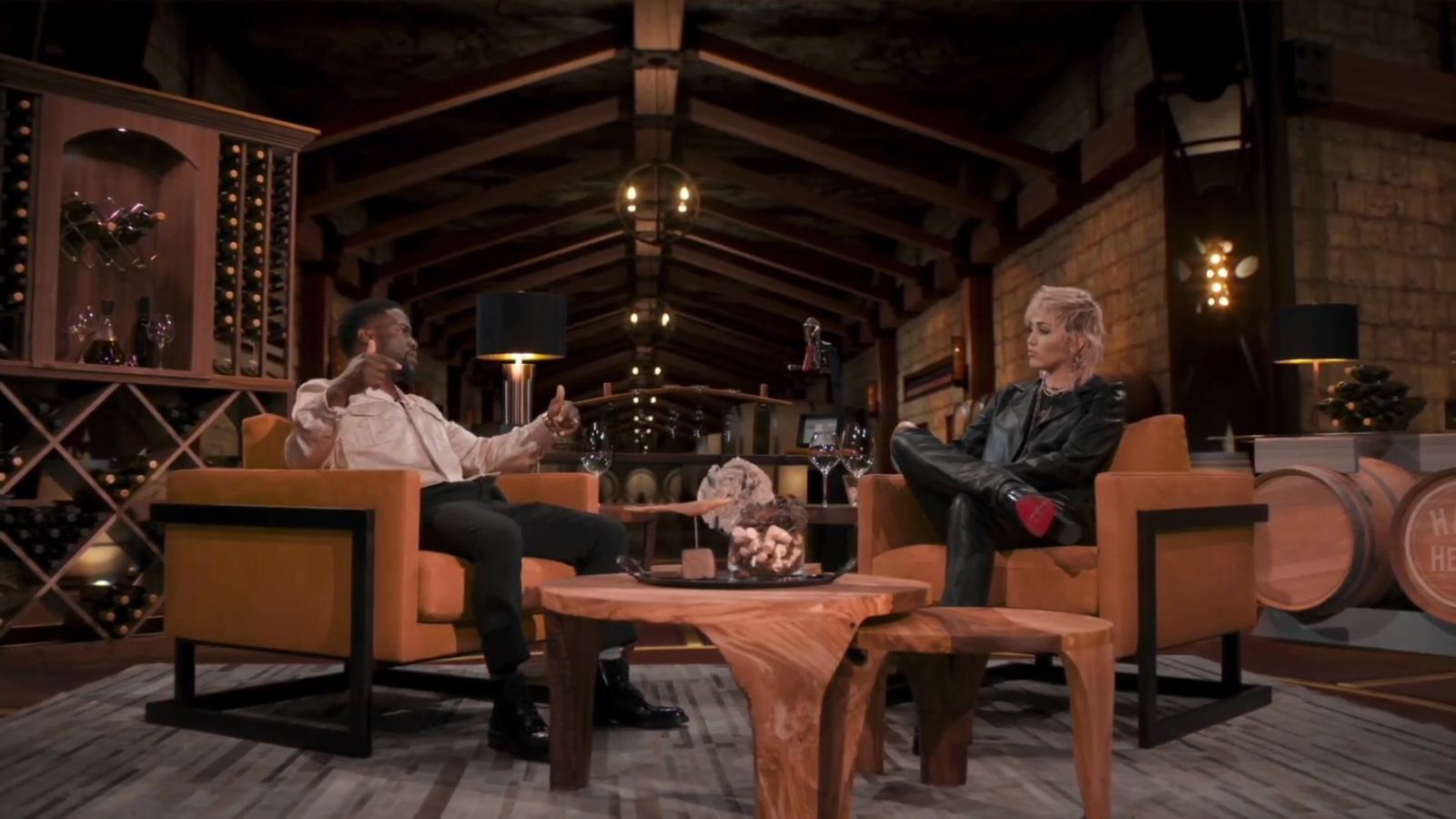
The proof is in the tapings. Kevin Hart’s Hart to Heart (NBC/Peacock) shot on our Burbank stage inside a grand winery environment. Watch guest Bryan Cranston make a point of how spectacular the set looks. LeBron James’ talk show taped here with guest Tony Hawk, and the Safe Haven talk show was staged on our broadcast set. For a fuller treatment of the trade-offs, here’s virtual vs. traditional talk show sets, compared.
What a talk show set costs: build vs. virtual
There’s no honest single number for talk show set cost, because the two paths have different shapes, not just different totals.
The build path stacks one-time and recurring costs: set design fees, construction labor and materials, paint and finish, transport, studio days consumed by load-in and strike, and storage between seasons. Every change to the look (a refresh, a rebrand, a new season) reopens most of that list. The set is an asset you keep paying for.
The virtual path folds the set into the stage: the environment library and the system that drives it come with the room, so the set cost is inside the day rate, and a look change costs minutes of load time instead of a construction cycle. What remains real (desk, chairs, foreground dressing) is a fraction of a full build. One logistical note if you’re comparing our two stages: filming in Burbank presently requires a film permit; at our Albuquerque stage, no film permit is required.
The way to compare quotes is to make every stage answer the same questions: what does the rate include, what’s optional, how fast can the look change, and what does episode 40 cost relative to episode 1?
The set is half the show. If you’re scoping talk show set rental in Los Angeles, that page covers the stage, the standing looks and the booking details, the facility itself operates as a full TV studio rental in Burbank. And when the set is settled and you’re on to producing the show itself, rundown, coverage, crew, we’ve written that guide too. When you have a shortlist, book a studio tour and we’ll load those looks on the floor for your demo.
Frequently asked
- What does a talk show set include?
- Five things, on every show in the format: a home base (a desk and guest chairs, an interview lounge, or a morning-show couch); a backdrop with real depth, a city window, a skyline, a brick wall, or bright morning windows; lighting keyed for the host and every guest seat; a stage layout that gives three or more cameras clean angles, often with audience seating and a second performance area; and a teleprompter on the host camera. Everything else, band riser, jib, monitors, is an extension of those five.
- How do you set up a talk show stage?
- Place the home base against the strongest backdrop, then work outward: set three camera positions (a wide master, a single on the host, a single on the guest), light each seat with its own key and fill, hang the teleprompter on the host camera, and rake any audience seating so every row sees the desk over the camera line. The order matters. The backdrop and home base decide where everything else goes. The fast alternative is renting a stage where that layout already exists and has been taped on for years.
- What makes a good talk show backdrop?
- Depth and identity. A backdrop reads as broadcast when it has layers, a window frame, a mid-ground, a skyline behind it, and reads as cheap when it's a flat printed wall. It also has to be repeatable: the background behind the desk must look identical in episode 40 and episode 1. Virtual backdrops solve both at once. The environment has true parallax on camera moves, never fades or warps, and can change from a night skyline to a morning street between segments.
- How much does a talk show set cost?
- There's no single number. The cost depends entirely on which path you take. A physical build stacks design fees, construction labor and materials, paint and finish, studio days for load-in and strike, and storage between seasons, and any change to the look reopens most of that list. On a virtual stage the set is software: the environment is part of the stage's day rate, a new look costs minutes instead of a construction cycle, and there's nothing to store or strike. That difference, recurring build costs versus a rental rate, is the honest way to compare quotes.
Tags: