Game Show Stage Design: How Game Show Sets Are Built, Lit, and Rented
Search “game show stage” and you’re usually one of two people: a producer scoping what it takes to put a game format on its feet, or a designer working out why these sets look the way they do. Both land on the same underlying fact, a game show set isn’t a room, it’s a machine. A handful of fixed zones, engineered around one game mechanic and the cameras that have to cover it at speed. Here’s the anatomy: what every game show stage contains, how the lighting and coverage actually work, why the look changes between rounds. And what changes when the whole set becomes software, which is how game show sets in Los Angeles are increasingly rented today.
What a game show set consists of
Strip the branding off any format, a saturated 70s panel show, a primetime money game, a streaming revival, and the floor plan underneath is strikingly consistent. Five zones, arranged around sightlines.
The contestant area. Podiums or lecterns, and they earn their place. A podium hides the buzzer wiring, monitors and scoring hardware; gives nervous hands somewhere to go; and carries the name plate and score display that let a viewer read the game state at a glance. The spacing between contestant positions is a camera decision, not a comfort decision: each player needs a clean single, and the group needs to fit one wide shot with the host.
The host mark. The host works a small patch of floor at the hinge of the set, positioned so one turn of the shoulders moves them from addressing a contestant to addressing the board or the audience camera. Watch any veteran host and you’ll see the design working: they almost never need a full step to redirect the show’s attention.
The board. Every format has one visual anchor that is the show: the trivia grid, the prize wheel, the money ladder, the wall of numbered cases. It anchors the widest shot and drives the reveal: the moment the board changes state is the moment the show pays off, so designers give it scale and light it like a lead actor. Some formats are literally named after the set piece. NBC’s The Wall built its entire show around a four-story, 40-foot board.
The audience bank. Tiered, stadium-style seating facing the playing area, because reaction shots are cut into the edit like music cues. The bank sits opposite the set so reverse angles catch faces, and it doubles as a depth cue: an audience visible behind the cameras makes the taping feel like an event.
The camera positions. Not scenery, but they own real estate on the floor and dictate almost everything above. More on that below.
Lighting is half the design
A game show setting is really two designs wearing one look: the physical geometry, and the lighting states layered on top of it. The base state carries normal play. Chase sequences, light moving in patterns across the set, build tension under a question or a countdown. And the reveal state is the show’s exclamation point: the blackout-and-restore, the shift to gold on a win or red on a loss, the sudden pool of light that isolates a contestant for the final answer.
The 70s game show set did all of this with incandescent chase bulbs, starburst cladding and saturated color; modern shows do it with programmable fixtures and video surfaces. Different technology, identical job: the lighting tells the audience what the game state means before anyone says a word.
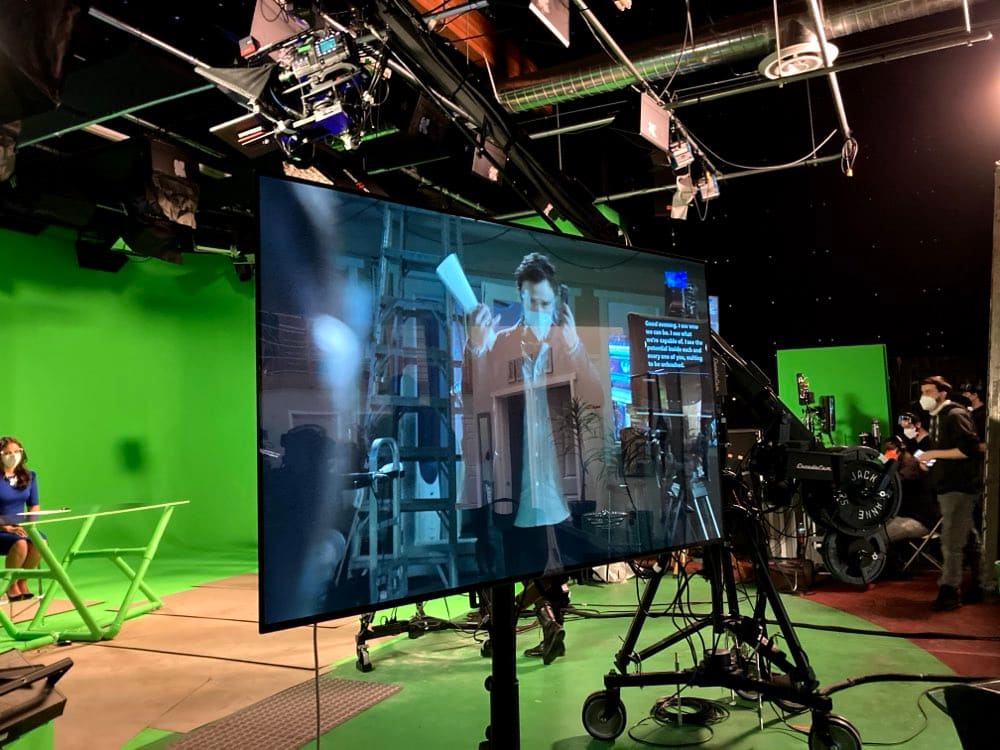
On our stages the split is clean. Physical fixtures light the people, and the set’s lighting lives inside the set, because the set is a photoreal environment rendered in real time and composited live in camera. This is virtual production beyond LED walls: green screen, Unreal Engine and live compositing, and the board glow, chase effects and reveal moments are part of the rendered world, firing on cue.
Game shows are coverage-hungry
Run the math on the standard game show setup: a wide that establishes the geography, a host camera, a clean single on every contestant, audience reactions and board inserts. A three-contestant format can have six-plus angles working at once, which is why game shows are multi-camera productions by definition. And why the floor plan above exists in the first place. The board, the podiums and the audience bank are positioned so that all those cameras can shoot simultaneously without crossing each other’s frames.
Speed matters as much as angles. Game shows tape multiple episodes a day, so the coverage plan has to reset in minutes, not hours. On our stage that means a multi-camera workflow with video village and real-time monitoring on the floor, producers review takes between rounds without anyone leaving the stage, and because the compositing is live, what’s on the monitors is the finished show.
The set changes between rounds
Round structure is look structure. Formats escalate, bigger money, fewer contestants, higher stakes, and the set escalates with them. Physical builds handle it with lighting states first, because light is the cheapest thing to change, then with machinery: turntables, flying units, motorized wagons rolled on during resets. The endgame look is practically a genre convention, the set contracts to a single pool of light, the color temperature drops, and the room tells you the stakes changed.
That machinery is also where physical game show sets get expensive. Every moving piece is engineering, maintenance and stagehands; every look change that can’t be done with light is a build.
When the entire set is software
On our Burbank and Albuquerque stages, the game show set is a photoreal environment rendered in real time and composited live in camera with our CastleVision method. We pioneered real-time virtual production in 2007, now patented. Real podiums, lecterns and props dress the foreground and blend into the environment, so the frame cuts like a built set. For game shows specifically, software rewrites the four most expensive facts of the format:
- The board changes between rounds in moments. A reconfiguration is a scene state, not a strike. The trivia grid becomes the endgame vault while the host is still thanking a departing contestant.
- Rebrands happen overnight. New season, new sponsor, new territory version of the format: that’s a design revision, not a shop build. The stage doesn’t care that the whole look changed.
- There’s nothing to store. Physical standing sets cost real money to warehouse between episodes and between seasons. A quiet line item that has killed shows at renewal. A virtual set stores as data. We charge zero storage fees, and your set loads for pickups or season two exactly as you left it.
- Scale is free. A four-story board renders at the same cost as a four-foot one. The set can look bigger than the stage because, in software, it is.
What that looks like on our stage
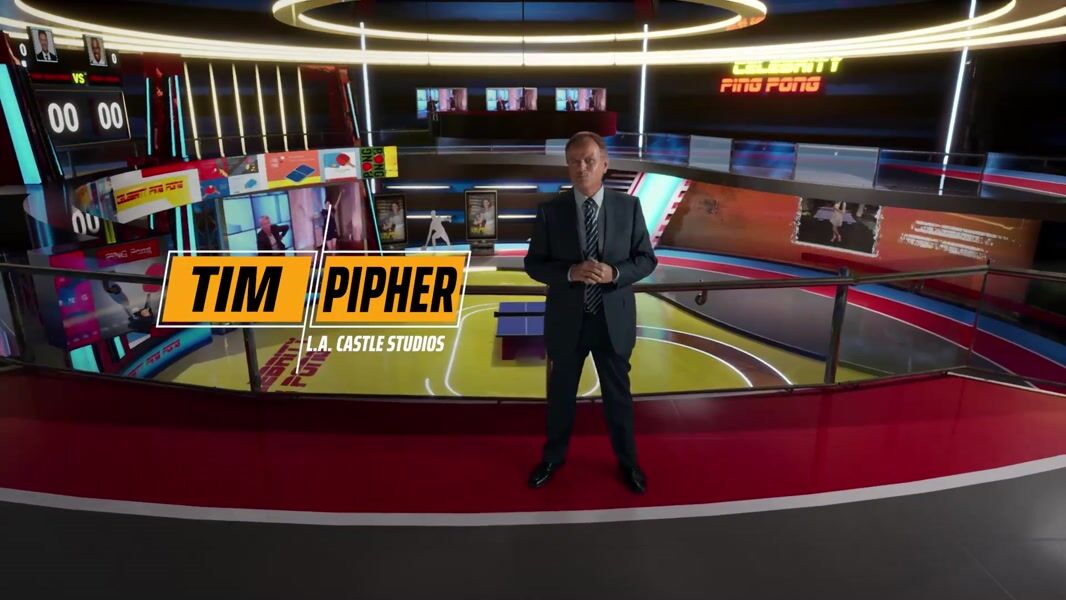
Network game-show productions have taped on our Burbank stage. The clearest single piece of proof is the massive custom game-show build in our video gallery, multiple shooting areas, an upstairs balcony, and photoreal floors that would cost a fortune if they were real. On the rental side, the Celebrity Ping Pong set in our Set Library is a two-level game show set with a working scoreboard, and the wall and floor graphics, colors and design are all customizable to your show. It is one of the looks behind our game show stage rental.
Renting a game show stage
The practical package, if you’re comparing game show studio options: our Burbank studio has stadium-style audience seating, green rooms and dressing rooms, 20+ parking spaces and easy load-in for the podiums and props you’ll bring, and the same pipeline runs at our Albuquerque studio, which seats an audience too (filming in Burbank presently requires a film permit; in Albuquerque it doesn’t). The virtual system operator who drives the environment is always included in the rate, and a teleprompter system is included as well; camera operators and a teleprompter operator are available as an optional crew package.
Two pointers to keep your search straight. This guide covers how a game show stage is designed and built; if what you want is a map of which famous lots and stages the big formats tape on, that’s covered in where they’re filmed. And if the game floor is one piece of a bigger slate, our TV studio rental page covers the stage beyond the format. For the format itself, the floor plan, the board, the audience bank and the coverage, start with game show sets in Los Angeles and tell us what your game needs.
Frequently asked
- What does a game show set consist of?
- Nearly every game show set breaks down into five zones: a contestant area (podiums or lecterns wired for buzzers and scoring), a host mark positioned between the contestants and the game board, the board itself, the money wall, wheel, grid or ladder that anchors the widest shot, an audience bank with tiered seating for reaction coverage, and the camera positions that tie it all together. The graphics, colors and branding change from show to show; the floor plan barely does.
- How are game show stages designed?
- Backwards from the game mechanic and the camera coverage. Designers start with the board, the visual element that expresses the game, then place contestants so each one faces the host, the board and a dedicated camera at once, set the host mark at the hinge between the contestant area and the board, and bank the audience where reverse angles can catch reactions. Lighting is designed in states: a base look for normal play, chase and build cues for tension, and a reveal look for wins and losses. On a virtual production stage the same design work happens in software instead of a scene shop.
- Can you rent a game show set?
- Yes. Beyond the traditional route of leasing a stage and building a set from scratch, virtual production stages rent complete game show environments that load in seconds and get customized to your branding. At L.A. Castle Studios in Burbank (stadium-style audience seating) and ABQ Castle Studios in Albuquerque (audience seating as well), the set is rendered photoreal in real time and composited live in camera, real podiums and props dress the foreground, and there are zero storage fees between episodes or seasons.
- How do game shows change their set between rounds?
- Physical shows do it with lighting states, board reconfigurations and motorized set pieces, turntables, flying units, wagons rolled on during commercial resets. On a virtual production stage the round change is a scene state: the board redraws, the environment reconfigures and the lighting look shifts in moments, because the entire set is software rendered live in camera.
Tags: